-
Fri 14th Oct 2011 08:35 #1 / 22
So whats mathematically the best defense:
A) 4-2
B) 5-1
C) 3-3
Thanks!
-
Fri 14th Oct 2011 11:45 #2 / 22
When you say "4-2"' Do you mean attacker has 4 sides and defender has 2?
-
 Fri 14th Oct 2011 12:02 #3 / 22
I believe he means spreading out units behind a defense... should you have 4 on the outside with a 2 behind it, a 5 protecting 1's, or double thick even 3's...
It kind of depends on the game you're playing... Statistically, I imagine that 4-2 will end up being your best bet. In heavy fog, I would do 5-1 and in a vicious battle of attrition, I would do 3-3.
-
Fri 14th Oct 2011 21:43 #4 / 22
Standard Member

- Rank
- Brigadier General
- Rank Posn
- #35
- Join Date
- Jun 11
- Location

- Posts
- 546
Hey Yuri,
That’s a great question, those types of problems always
intrigue me - especially since that situation occurs often in the beginning of
Wargear Warfare games. There are lots of ways to consider how to answer that. The
first approach I took is to determine the probability of an opponent taking
both territories in each of the three scenarios. It would be necessary to calculate the
probability for different starting strengths of your opponent, but I worked out
some probabilities assuming your opponent attacks from a territory having 6
armies with the intention of taking both the territories in question,1st territory 2ndterritory Odds to take 1st Oddsto take 2nd Odds to takeboth
5 1 41% 88% 35.6% (.41 x .88)
4 2 50% 66% 32.6%
3 3 68% 49% 33.5%
The odds are based on the attacker stopping the attack when odds no longer favor another attack. For example they would not attack 3 v 2 (rolling 2 v 2) or 2 v 1 (rolling 1 v 1). The odds to take the 2nd
territory are based on the distribution of the successful attacks on the first
country. For example, a certain percentage of the time the attacker will have 6 armies left after the first
attack, 5 armies some of the time, etc. Having said that, I just realized that I forget to deduct one army from each scenario after the first attack to account for leaving one army behind as
you move into the conquered territory. I will recalc on Monday and post the new results.
But I think the results above still give some insight. 4,2 and 3,3 are about the same with 5,1
having a slightly less effective defense. This I think is because the attacker has better odds against the 1 army territory on the second attack.Edited Fri 14th Oct 21:45 [history]
-
Sat 15th Oct 2011 08:57 #5 / 22
Ah thanks, that was exactly what i was looking for!
-
Sat 15th Oct 2011 11:31 #6 / 22
"If an incompetent chieftain is removed, seldom do we appoint his highest-ranking subordinate to his place" - Attila the Hun
SquintGnome wrote:
Hey Yuri,
That’s a great question, those types of problems always
intrigue me - especially since that situation occurs often in the beginning of
Wargear Warfare games. There are lots of ways to consider how to answer that. The
first approach I took is to determine the probability of an opponent taking
both territories in each of the three scenarios. It would be necessary to calculate the
probability for different starting strengths of your opponent, but I worked out
some probabilities assuming your opponent attacks from a territory having 6
armies with the intention of taking both the territories in question,1st territory 2ndterritory Odds to take 1st Oddsto take 2nd Odds to takeboth
5 1 41% 88% 35.6% (.41 x .88)
4 2 50% 66% 32.6%
3 3 68% 49% 33.5%
The odds are based on the attacker stopping the attack when odds no longer favor another attack. For example they would not attack 3 v 2 (rolling 2 v 2) or 2 v 1 (rolling 1 v 1). The odds to take the 2nd
territory are based on the distribution of the successful attacks on the first
country. For example, a certain percentage of the time the attacker will have 6 armies left after the first
attack, 5 armies some of the time, etc. Having said that, I just realized that I forget to deduct one army from each scenario after the first attack to account for leaving one army behind as
you move into the conquered territory. I will recalc on Monday and post the new results.
But I think the results above still give some insight. 4,2 and 3,3 are about the same with 5,1
having a slightly less effective defense. This I think is because the attacker has better odds against the 1 army territory on the second attack.Good analysis Squint.
-
Sun 16th Oct 2011 21:10 #7 / 22
thanks squint! now i know what to do :P
-
Mon 17th Oct 2011 19:21 #8 / 22
Standard Member
- Rank
- Brigadier General
- Rank Posn
- #35
- Join Date
- Jun 11
- Location
- Posts
- 546
Attack Units Defender Units Start 1st 2nd Win % % Attacker Units Remaining after Win Win % Win % Terr Terr Terr 1st Terr 7 6 5 4 3 2nd Terr Both 6 5 1 40.5 0 22.5 30.4 36.2 10.9 68.4 27.69 6 4 2 56.1 0 24.6 29.2 31.6 14.6 32.7 18.35 6 3 3 68.0 0 36.1 30.6 25.7 7.7 29.3 19.91 7 5 1 57.2 15.9 21.5 25.6 25.6 11.4 72.8 41.66 7 4 2 66.4 20.8 24.7 26.7 21.3 6.4 49.2 32.65 7 3 3 82.8 29.6 25.1 21.1 16.1 8.1 40.5 33.52 Edited Mon 17th Oct 19:22 [history]
-
Mon 17th Oct 2011 19:32 #9 / 22
Standard Member
- Rank
- Brigadier General
- Rank Posn
- #35
- Join Date
- Jun 11
- Location
- Posts
- 546
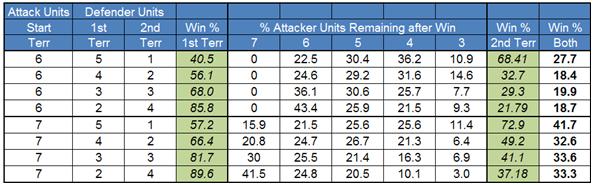
In the post above are updated calcs from last week, and I added rows assuming the attacker starts with seven armies also.
The leftmost column shows how many units the attacker starts with and the next two shows how you place the defenders. The columns after the Win % first column show the distribution of units when the attacker wins the first battle. So, for example, in the first row if the attacker wins the battle, 22.5% of the time he will have six units left (this is only .405 x .225 = 9.1% of all attacks he makes). Based on this distribution the attacker will have a certain probability to take the second territory, 68.4% in this case. Multiplying both gives the probability to win both on a turn.
So, the conclusion is that leaving only 1 in the second territory you wish to keep is not a favorable strategy. Leaving 2 or 3 is about the same.
As an interesting side note Yuri you posted about a common starting position on Wargear Warfare where you place units against two territories holding 3 each. This happens often in Australia or SA when you hold a territory, a neutral holds one, and your opponent holds two. If you place all 4 there you have about a 1 in 3 chance to take both your opponents territories.
-
Sat 30th Jun 2012 00:28 #10 / 22
Lets say the territory of interest is the one in the back, is a 2-4 defense still the best way to go?
-
Tue 3rd Jul 2012 16:31 #11 / 22
Standard Member
- Rank
- Brigadier General
- Rank Posn
- #35
- Join Date
- Jun 11
- Location
- Posts
- 546
Hey 3Eyed, I am working on the stats for your question, should have an answer Thursday. It is something interesting to consider.
-
Tue 3rd Jul 2012 20:05 #12 / 22
Ok awesome, thanks SquintGnome!
-
Wed 4th Jul 2012 12:28 #13 / 22
This site:
http://gamesbyemail.com/Games/Gambit/BattleOdds
does a good job of letting you run "what if" scenarios, giving the odds that a given number of attackers will succeed against a given sequence of defenders. But it assumes D6 v D6 and that you attack to the last man.
This one:
http://www.prestopnik.com/wargear/
calculates odds for non-standard dice but doesn't let you specify a multi-territory march.
-
Wed 4th Jul 2012 13:31 #14 / 22
Standard Member
- Rank
- Brigadier General
- Rank Posn
- #35
- Join Date
- Jun 11
- Location
- Posts
- 546
Those are good sites.
There turns out to be a significant difference between attacking to the last man and attacking until the odds no longer favor for smaller battles. The stats I generate assume that the attacker will stop when the odds are no longer in their favor. For example, one will not attack 3 v 2 (2 dice vs 2 dice), 3 v 3, 2 v 2, or 2 v 1.
If I can rember I will post some examples that give the actual odds comparing the two philosophies.
-
Thu 5th Jul 2012 18:14 #15 / 22
Standard Member
- Rank
- Brigadier General
- Rank Posn
- #35
- Join Date
- Jun 11
- Location
- Posts
- 546
-
Thu 5th Jul 2012 18:20 #16 / 22
Standard Member
- Rank
- Brigadier General
- Rank Posn
- #35
- Join Date
- Jun 11
- Location
- Posts
- 546
Hey 3Eyed, here is the answer to your question. You can read some of the posts above for details on the table, but there is almost no difference between defending 2-4 or 4-2 in either case.
Also, I have some data here on the statistical difference between assuming 'attack to the last man' and 'attack until odds do not favor' The list below is for a territory with 6 attacking various numbers of defenders.
Defenders Win% - to last man Win% - until odds do not favor
1 99 98.4
2 89 85.8
3 77 68.0
4 64 56.1
5 51 40.5
As the battles get 'tougher' with more defenders the differnce increases. this is because battles with closer numbers of attackers and defenders have a higher proportion of scenarios where an attacker would stop attacking because the odds do not favor it.
-
Fri 6th Jul 2012 17:55 #17 / 22
Ok thanks so much, this really helped!
-
Mon 6th Aug 2012 02:49 #18 / 22
Another way to cut this calculation would be average number of attacking pieces lost assuming higher attacking numbers (assume infinite) for calc purposes - as this would show the value of leaving reserves dotted about behind you lines
Oh and have you calculated the fact that at least one unit must be left behind when 1st territory taken?
Edited Mon 6th Aug 02:55 [history]
-
Mon 6th Aug 2012 06:48 #19 / 22
Standard Member
- Rank
- Brigadier General
- Rank Posn
- #35
- Join Date
- Jun 11
- Location
- Posts
- 546
Hi Steaton,
Yes, the calcs assume the need to leave one unit behind. I agree that leaving units behind your lines will increase your defensive effectivenss. Usually though most units are stacked on the front lines to increase offensive capability.
-
Tue 14th Aug 2012 10:15 #20 / 22
Good night! If anyone, is ever, at all interested in playing risk (type games), this is T H E standard question you ask yourself. 4-2 it is!